

Brief Overview
An interactive gamified dashboard inside Unacademy that turns exam revision into a streak-based game making progress visible, learning consistent, and motivation effortless.
Systems Thinking
Gamification in EdTech
UX + Interaction Design
Student Motivation
😖
Racing Against Revision
Cramming before exams often turns into a panic sprint. Students revise endlessly yet rarely know if they’re truly ready.
💡
From Pressure to Progress
I realised the problem wasn’t knowledge, but motivation. Small wins stayed invisible and so did progress.
🎯
RapidRevise Takes Shape
A gamified dashboard inside Unacademy that turns revision into a streak-based game. Every badge, streak, and progress bar becomes a tiny confidence boost.


Setting the Context
The Spark: Where It All Began
01
Choosing the System
We began by selecting a system that resonated with our interests - Education. With its deep societal impact and evolving nature, it became the perfect ground for exploration and intervention.
Systems Thinking as a group
Education System In India

Why did we choose this topic?
Education in India is a complex, deeply layered system that offers rich opportunities for applying systems thinking and design. Interconnected System that has visible gaps & can foster real impact. Evolving Technological Integration along with our personal relevance and familiarity also pushed us to pursue this topic

02
Mapping the Actors of the System
The actor map categorizes stakeholders into three layers:
Primary
Core participants like students, teachers, parents, and education boards.
This layered view helps identify relationships (in the following slide)
Secondary
Supportive bodies such as ed-tech companies, coaching centers, and employers.
Tertiary
Indirect influencers like NGOs, media, activists, and entrepreneurs.
03
Knowledge Graph
This graph maps the flow of information, influence, and resources among stakeholders. It highlights key connections between students, institutions, policy makers, and support systems, showing how knowledge is created, shared, and applied across the ecosystem. This helps identify leverage points.

04
Identifying Sub-systems
The education system in India is composed of interconnected sub-systems such as formal and informal education, financial, cultural, regulatory, assessment, infrastructure, and employment. Mapping these helps in understanding the systemic complexity & focusing deeper in our system map

05
System Map
To understand the complexities of the education ecosystem, we created a system map capturing all the visible and invisible connections. This helped us visualise how various components interact, influence, and co-depend within the system.


We then mapped feedback loops to understand how the system responds to internal changes. This helped us uncover patterns and areas where small interventions could trigger larger, positive impacts.
06
Feedback Loops

*Dot voting to select the loop for further steps.
Mapping more factors from the Motivation Loop to niche down upon

Motivation Loop
After identifying key feedback loops within the education system, we zoomed in on one that stood out - the Motivation -Achievement Loop to better understand what keeps students engaged.
Defining I How might we

HMW design systems that provide real-time motivation and track small achievements to boost confidence for students?
System Map - II
Diverging on more factors with the idea of student motivation

Surveying Students:
Understanding Motivation Firsthand


Key findings/paterns in the survey

Thought provoking Responses...

Initial Ideations
Drawing from the survey responses and in-depth evaluation, we translated key insights into a set of initial ideas. These early concepts aimed to address motivation gaps and explore playful, effective ways to support consistent revision habits.

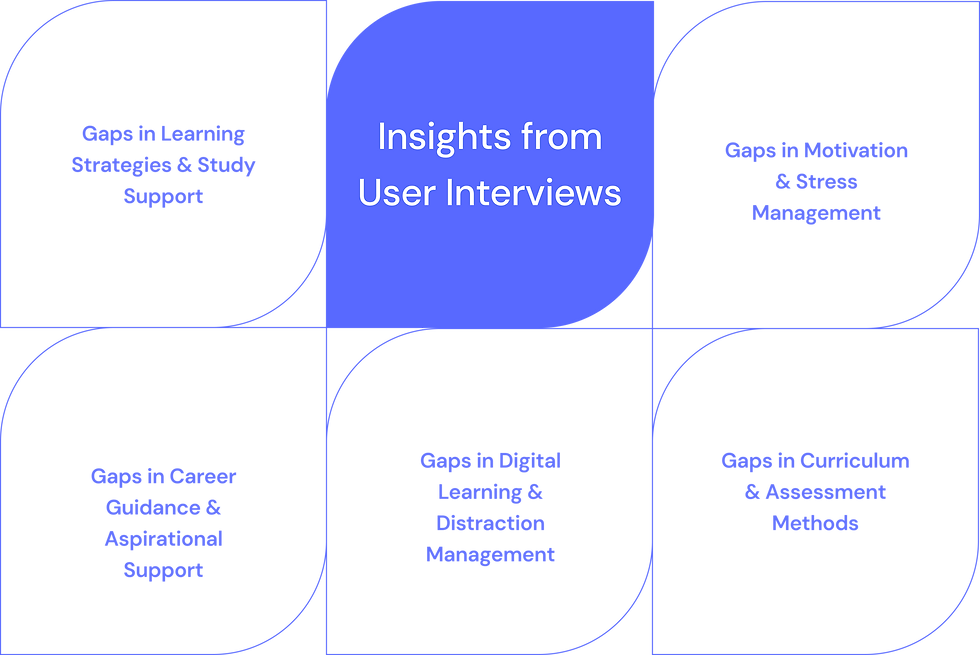
After our initial round of ideation, we conducted a second phase of primary research through one-on-one interviews to better understand students' personal thoughts on motivation and their daily learning habits.
We interviewed 10 students from Platinum City, Peenya, capturing deeper insights into what drives or disrupts their motivation — straight from their own lived experiences.

Digging Deeper:
One-on-One Student Interviews
Stepping Into Their Shoes :
Creating the Empathy Map
After conducting one-on-one interviews with students, we analysed the insights to better understand their behaviours, emotions, and thought processes. The next step was to create an empathy map, a tool that allowed us to synthesise what students say, think, do, and feel.
This step was crucial because it helped us move beyond surface-level data and build a more human-centred understanding of our users. By mapping out their internal motivations and external actions, we were able to uncover hidden tensions and identify real design opportunities that could genuinely support their learning journey.

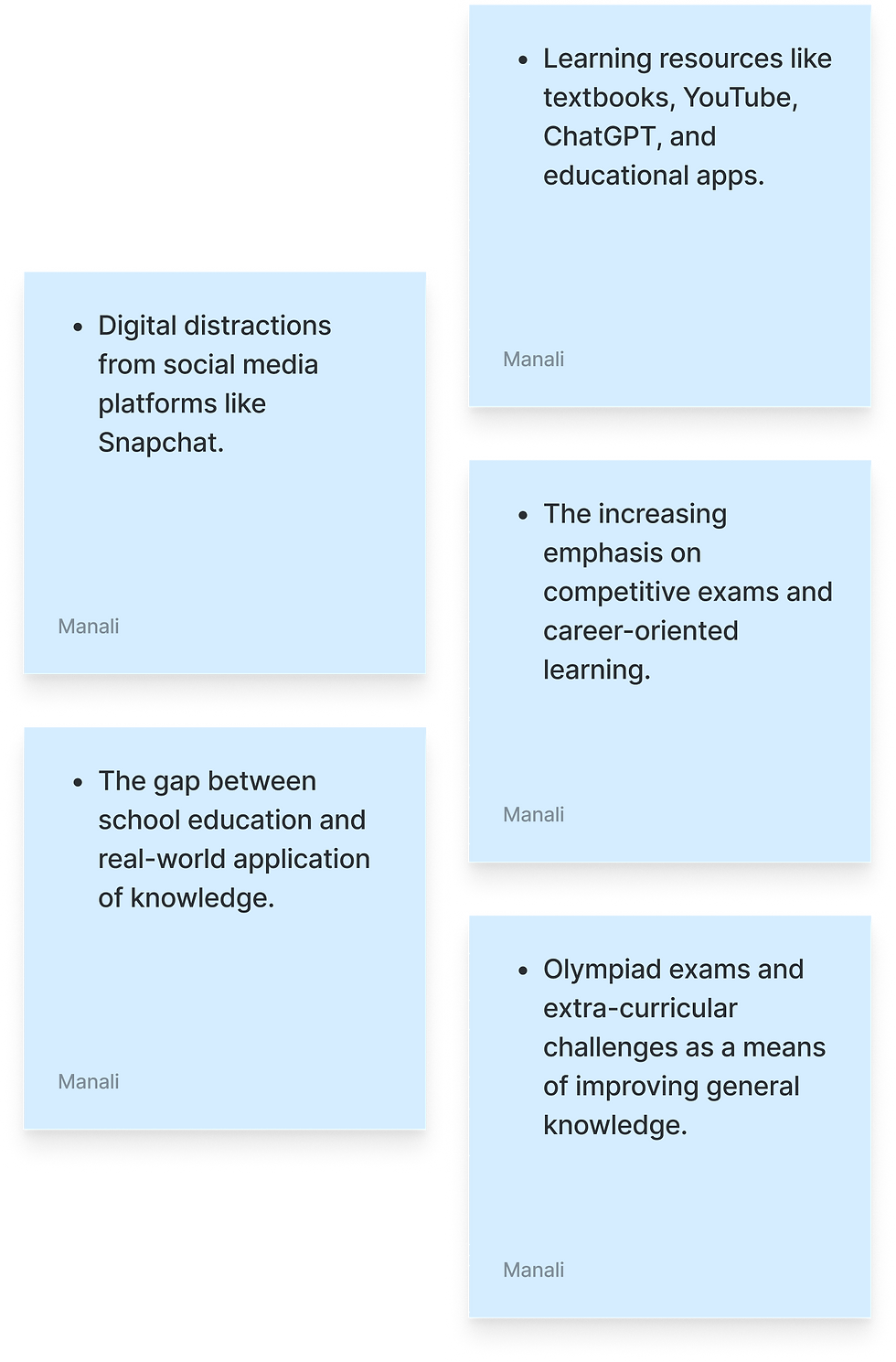

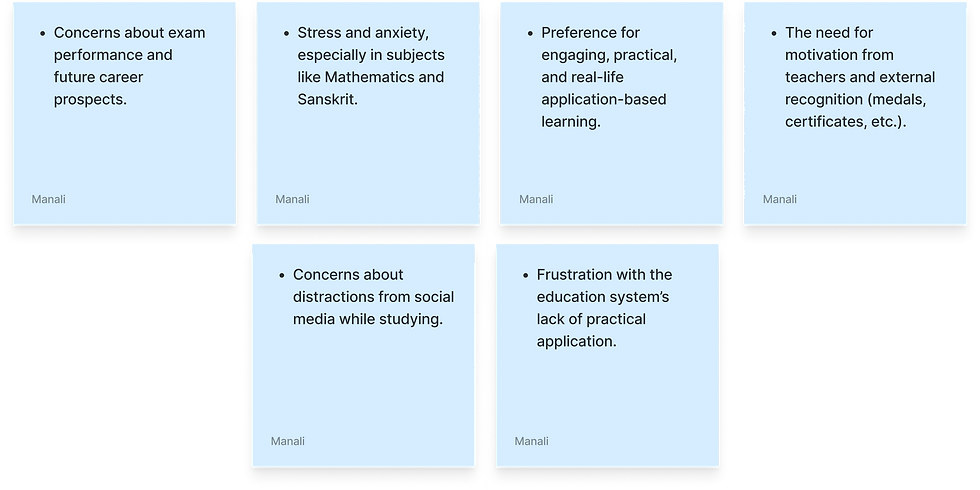


Note : Up to here, i.e. the stage of interview analysis, the research and insights were developed collaboratively as a group. The upcoming process, i.e., from identifying opportunity areas onward, including ideation, concept development, and the final solution, transitioned the project into an individual exploration.
From Empathy to Opportunity :
Defining the Problem Statement
Through empathy mapping, I identified key pains and gains experienced by students in their learning journey.
One major insight stood out - while students today have access to high-quality online education platforms, their assessment experience remains outdated and uninspiring.
Most platforms still rely on traditional, long-form tests that are 2–3 hours long, making the process monotonous and mentally exhausting. This not only impacts engagement but also hinders consistent self-assessment and progress tracking in a motivating way.

In recent years, online learning in India has seen exponential growth, becoming an integral part of the educational landscape. Platforms are not just delivering content; they’re reshaping how students learn, practice, and grow.
According to recent insights:
-
80% of parents have observed academic improvement in their children through experiential online schools.
-
Reports highlight a surge in trust in edtech platforms like Physics Wallah, Unacademy, and others, reflecting a broader acceptance of virtual education.
-
Gen Z and millennials are turning to online modes to upskill, prepare for exams, and stay competitive, especially amidst traditional educational challenges.
This transformation is not just about convenience; it’s about accessibility, personalisation, and engagement. However, one of the biggest opportunities lies in rethinking assessments to be as dynamic and engaging as the content itself.
“As the education landscape shifts toward digital platforms, gamified learning emerges as a natural response to student needs, especially in a country like India with a young, digital-native population.”


Where Gamified Learning Fits In

Redefining the Problem Statement
Backed by secondary research and real user insights, this led to a refined problem statement:
“Students have access to quality online learning platforms like Byju’s and Unacademy, but their knowledge assessment is limited to long, monotonous 2–3 hour tests. This traditional testing format reduces engagement and motivation, making it difficult for students to track their progress interactively and enjoyably.”
🌍
Context & Background
Students currently rely on long, traditional tests to assess their knowledge, which can feel monotonous and discouraging.
While Unacademy provides excellent learning resources, there is a need for an engaging and interactive way to test students' understanding of subjects and topics in a fun, rewarding manner.
👤
Target Audience
Students currently rely on long, traditional tests to assess their knowledge, which can feel monotonous and discouraging.
While Unacademy provides excellent learning resources, there is a need for an engaging and interactive way to test students' understanding of subjects and topics in a fun, rewarding manner.
🎯
Objective
To integrate a gamified assessment layer within the Unacademy Learners App that allows students to test their knowledge through quick, interactive games. This feature will enhance engagement, making revision enjoyable while providing meaningful insights into their learning progress.
Competitor Analysis
Platform
Strength
Weakness
USP

-
Wide Range of courses
-
Freemium model with free & paid content
-
Live Interactive classes
-
Strong educator network
-
Highly competitive market
-
Focuses more on video-based learning than gamification
-
Large educator network & competitive exam preparation leader
-
High quality animated lessons
-
Personalised learning paths
-
Compromised brand reputation
-
Expensive subscription model
-
Criticised for aggressive marketing
-
Strongest in conceptual visualisation & interactive videos

-
Live one-on-one tutoring
-
Interactive WAVE learning platform
-
High operational costs
-
Scalability challenges due to live sessions

-
Real time interactive learning & tutor availability

-
University tie-ups for career advancements
-
Industry relevant courses
-
Expensive courses
-
Not focused on school education
-
Higher education & career-focused learning

Design Brief

To enhance the Unacademy Learners App by integrating a gamified assessment layer that allows students to test their knowledge through interactive, subject-specific mini-games.
This feature will replace monotonous long-format tests with engaging, rewarding experiences that promote active learning and retention. The system will include adaptive challenges, real-time feedback, progress tracking, and a rewards mechanism to make revision enjoyable and effective.


user persona


user Stories


RapidRevise is a gamified assessment feature designed to revise quickly, effectively, and in a fun way for school students. Integrated into the Unacademy Learners App, it allows students to test their knowledge through short, interactive mini-games tailored to specific subjects and topics. With features like timed challenges, instant feedback, adaptive difficulty, and rewards, RapidRevise transforms boring test prep into an engaging, confidence-boosting experience.
Colour and Typography

How RapidRevise Reaches Learners
Step 2: Explore
Curious, he taps the notification and lands on the Unacademy Learners App homepage. A prominent CTA banner invites him to try RapidRevise.

Step 1: Discover
User receives a push notification from the Unacademy app:
"Unacademy’s new feature is live: RapidRevise. Quick games to boost your prep. Check it out!"
Step 3: Dive In
With a single tap, user enters the RapidRevise section - a hub of bite-sized, subject-specific mini-games designed to make revision fun, fast, and focused.


Let’s explore the games through specific use cases to understand them better.

Quick Revision Before an Exam
Scenario:
Riya, a Class 10 student, has her math exam tomorrow. She has already reviewed her notes but wants a quick way to test herself without having to reread everything.
Problem:
Traditional tests take too long, and she doesn’t want to go through a boring, lengthy assessment. She needs something fast and engaging.
Tracking Progress and Staying Motivated
Scenario:
Neha, an engineering aspirant, has been preparing for JEE Physics for months. She often feels demotivated because she doesn’t see clear progress.
Problem:
She wants real-time insights into her improvement rather than just taking mock tests.
Learning Through Friendly Competition
Scenario:
Amit and his best friend, Rahul, are preparing for NEET Biology. They both study from Unacademy but find traditional assessments boring.
Problem:
They need a fun way to revise together, rather than just taking regular tests.